
How to Get Scratches Out of Leather Easily: A Practical Guide
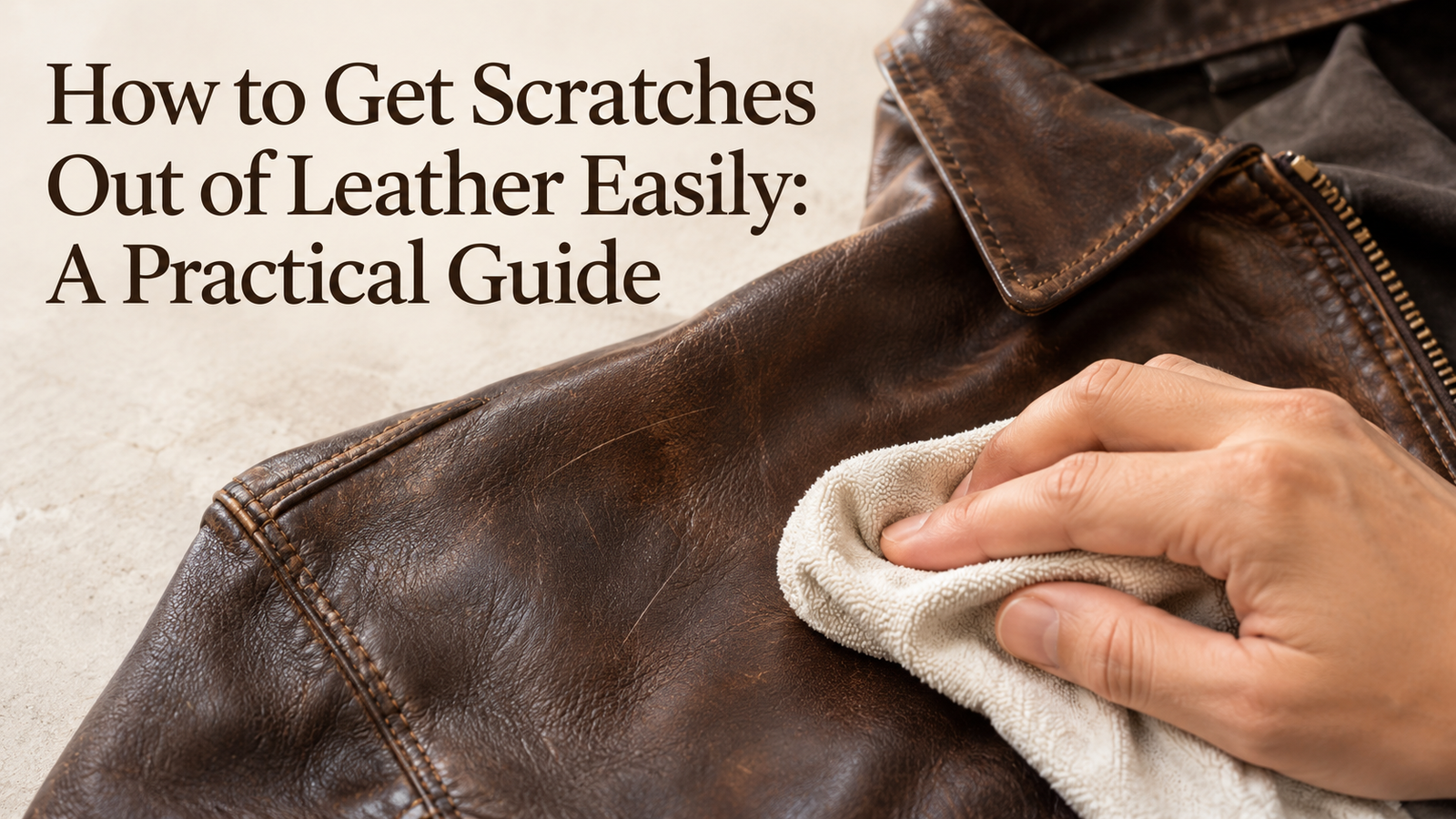
You put on your favourite leather jacket, catch the sleeve against a door, and suddenly notice a pale scratch across it. Before reaching for a cleaning product, take a closer look: the right treatment depends on the leather and the depth of the mark.
If you’re wondering how to get scratches out of leather easily, start with the gentlest approach. This guide will help you identify the scratch, choose a suitable treatment, and avoid mistakes that could make the damage more noticeable.
Quick Answer: How Do You Remove Scratches From Leather?
To make a light scratch less visible, first check the jacket’s care label and gently wipe away loose dust with a clean, soft cloth. On suitable smooth leather, a small amount of manufacturer-approved leather conditioner may help blend a superficial mark. Test any product on a hidden area first. Deep cuts, missing colour, suede and delicate finishes often need specialist attention.
A conditioner can improve the appearance of some surface scratches, but it cannot replace missing leather or guarantee an invisible repair.
Before You Start: Identify the Leather and the Scratch
The same mark can respond differently on two jackets. A soft, natural-looking leather may develop a temporary colour change when rubbed, while a coated jacket may have lost part of its surface finish.
Start by checking the care label or product description. If it doesn’t explain the finish, contact the seller or manufacturer before applying a treatment. Terms such as “genuine leather” and “lambskin” describe the material but do not tell you everything about its surface finish.
Common leather finishes
· Pigmented or finished leather: Smooth leather with a protective coloured surface. Light scuffs and small areas of colour loss may sometimes be improved with a compatible product.
· Aniline or other absorbent leather: Usually soft and natural-looking, but more likely to absorb liquids and darken unevenly. Ask the manufacturer or a specialist before treating it.
· Suede or nubuck: Has a soft, brushed surface. It needs suede-specific care, not ordinary smooth-leather creams.
· Faux leather: Usually has a synthetic surface layer. Leather conditioner will not repair peeling or restore a damaged coating.
Leather-care specialists emphasise that different finishes need different treatments, especially when dealing with suede and absorbent leather.
How deep is the scratch?
Look at the mark in natural light and gently run a clean fingertip across it. Don’t press hard or pull at loose material.
What you see | Likely issue | Best first step |
A faint line with no visible break | Light surface mark | Gently wipe with a soft, dry cloth |
A pale scuff where colour appears missing | Surface finish or colour damage | Ask about a compatible colour repair |
A groove you can feel | Deeper scratch | Get a leather specialist’s assessment |
A lifted flap, cut or tear | Structural damage | Stop handling it and seek professional repair |
A lighter or darker line on suede | Brushed fibres may have changed direction | Try a gentle suede brush if the care label allows |
If you’re unsure which category fits, start with the dry cloth and stop there until you have more information. Trying several products at once can make it harder for a professional to restore the original finish.
How to Get Scratches Out of Leather Easily: Step-by-Step
These steps are intended for minor marks on smooth leather. They are not a repair method for tears, suede, peeling faux leather or a jacket with an unknown finish.
Step 1: Check the care label
Look for instructions about cleaning, conditioning and professional care. If the label says specialist cleaning only, follow that advice.
Pay particular attention to jackets with metallic finishes, unusual colours, printed designs or decorative coatings. Even a mild product can change their appearance.
Step 2: Remove loose dust
Lay the jacket on a clean, flat surface. Use a soft, dry, lint-free cloth to gently wipe around the scratched area.
Avoid scrubbing. Your aim is simply to remove loose dust so you can see the mark clearly and avoid rubbing grit across the surface.
Step 3: Try a gentle fingertip or cloth
If the leather’s care instructions allow handling the surface, lightly rub the mark with a clean fingertip or soft cloth. Some very superficial marks, especially on certain waxed or oil-treated leathers, may become less visible with gentle rubbing.
Stop if the colour changes unevenly, the surface becomes shiny, or the mark looks worse. Not every scratch will respond, and more pressure is unlikely to fix damaged colour or fibres.
Step 4: Test a suitable product
If the mark remains and the manufacturer recommends a conditioner or treatment for your specific finish, test it on a small, concealed area, such as an inside hem.
Follow the product’s instructions and allow the test area to dry fully. Check for darkening, stickiness, colour transfer or a change in shine before proceeding.
A patch test reduces risk, but it doesn’t guarantee the result will look identical on a more visible panel. If the test changes the finish, don’t use the product on the scratch.
Step 5: Apply sparingly, if appropriate
If the test looks satisfactory, use only the amount and method recommended on the product label. Work gently with a clean, soft cloth and let the area dry naturally.
Don’t soak the jacket or place it near a radiator to speed up drying. Once dry, inspect it in daylight. A light scratch may blend in, but a deeper line can remain visible.
Remember: A jacket that isn’t dry or stiff doesn’t automatically need conditioner. More product can leave the surface darker, greasy or uneven.
Step 6: Decide whether to stop
If the scratch looks better, leave the jacket alone. If it still shows exposed colour loss, raised fibres or a groove, consider professional repair rather than repeating the treatment.
Sometimes a small mark is part of the leather’s developing character. The goal is to care for the jacket without turning a tiny scratch into a larger patch of discolouration.
Looking for your next everyday layer? Explore our best selling mens leather jacket collection and find a style you’ll want to wear for years.
Can You Fix Deep Scratches on a Leather Jacket?
Deep scratches are more difficult because the damage may go beyond the surface colour. If you can feel a groove, see loose fibres, or notice a flap of leather, a conditioner will not rebuild the damaged area.
A leather repair specialist may assess whether the jacket needs careful cleaning, reinforcement, flexible filler or colour matching. The right method depends on the leather, the location of the damage and how much the area bends when worn.
For example, a repair on an elbow needs to remain flexible. A thick, poorly matched DIY coating may crack or stand out every time you move your arm.
Before booking a repair, take clear photos in daylight and ask:
1. Have you repaired jackets with this type of leather and finish?
2. Will the repair remain flexible in that area?
3. How closely can you match the colour and sheen?
4. What will the repair cost, and what result should I reasonably expect?
A good specialist should explain that some damage can be improved without disappearing completely.
How to Handle Scratches on Different Leather Types
Smooth, finished leather
A light scuff on finished leather may affect only the protective surface. Start with a dry cloth and follow the jacket maker’s care instructions.
If colour has rubbed away, a colour-matched repair product may be an option only if it is designed for that finish and suitable for flexible garments. Test it first, and be cautious with visible areas: even black leather can vary in tone and shine.
Aniline and delicate leather
Aniline leather can absorb products quickly, making a small spot appear darker than the surrounding panel. A treatment that works on a coated jacket may leave a permanent-looking patch on an absorbent one.
For valuable, pale or delicate jackets, ask the manufacturer or a leather specialist for advice before using a cleaner, balm or conditioner. Some marks may be better left as natural wear.
Suede and nubuck
Suede and nubuck have a raised surface called the nap. A mark that looks like a scratch may simply be fibres lying in a different direction.
If the care label permits, gently brush the dry area with a soft suede brush. Use light strokes and follow the manufacturer’s directions. If the mark does not improve, or the fibres are damaged, speak to a specialist.
Why does suede change color when you touch it? The fibres shift direction and reflect light differently. That change in shade is often normal, although an actual scratch or stain may remain visible after brushing.
Faux leather
Faux leather can scratch, crack or peel when its synthetic coating is damaged. Standard leather conditioner will not restore that coating.
Check the care label and ask a repair specialist whether a flexible product is suitable for your jacket. If the material is peeling in several places, a lasting repair may be difficult.
Real-Life Examples: Which Approach Makes Sense?
A light scratch from a handbag strap
You notice a thin line on the shoulder of your smooth leather jacket after carrying a bag. There is no visible cut and the colour appears intact.
Start with a dry cloth. If the mark remains, check the care label before trying any product. To prevent the same spot from rubbing repeatedly, switch shoulders or choose a bag with a softer strap.
A pale scuff near the pocket
A zip has rubbed against the pocket edge, leaving a small pale patch. The surface feels mostly smooth, but some colour appears to be missing.
Conditioner may not replace that colour. Ask the manufacturer or a repair specialist whether a matching garment repair product is suitable, particularly if the jacket has a glossy or textured finish.
A scratch on a white leather jacket
A pale jacket can make even a small mark noticeable, but it can also make an uneven repair easy to see. Avoid applying coloured polish or an untested cream.
If you’re also researching how to clean a white leather jacket, treat cleaning and scratch repair as separate issues. A scuff may be transferred dirt, lost colour, or both. A specialist can help identify the difference before you change the finish.
A mark on a suede sleeve
After brushing against a chair, your suede sleeve looks darker in one direction. Gently brush the dry nap if the care instructions allow it.
If the mark remains rough or the fibres appear cut, stop brushing. Excess friction can change the texture across a larger area.
DIY Leather Scratch Repair: Pros and Cons
Approach | Pros | Cons |
Gentle cleaning and care at home | Low cost; convenient for minor surface marks; helps you inspect the jacket | Results vary; the wrong product can darken or damage the finish |
A suitable DIY colour product | May improve a small area of colour loss on compatible finished leather | Matching colour and shine can be difficult; unsuitable for many finishes |
Professional repair | Specialist can assess the material and deeper damage; better option for valuable jackets | Costs more; may take time; a perfect match is not guaranteed |
For a faint mark, a careful home approach may be enough. For a prominent scratch on the front of an expensive jacket, the cost of a professional assessment may be worthwhile.
Common Mistakes That Can Make Scratches Worse
1. Using olive oil or other kitchen oils
Kitchen oils can leave dark or greasy patches and may be difficult to remove. They are not a reliable substitute for a product approved for your jacket’s finish.
2. Applying shoe polish to a jacket
Shoe polish is made for footwear and may transfer onto clothes or produce the wrong sheen. Jacket leather also needs to flex around the shoulders and elbows.
3. Scrubbing hard
Strong rubbing can remove more colour or make a small scratch look like a large shiny patch. Use light pressure and stop if the surface changes.
4. Skipping the patch test
Even a product marketed for leather can react differently depending on the finish and dye. Test it somewhere hidden and let it dry before deciding whether to continue.
5. Using heat to “seal” a repair
A hair dryer, radiator or iron can dry or distort leather and may affect its finish. If you are also wondering how to iron a leather jacket, check the manufacturer’s instructions first; direct heat is risky, and professional care is the safer choice when the label is unclear.
6. Mixing several treatments
Applying cleaner, oil, balm and polish one after another can create buildup and make the original damage harder to assess. Use one appropriate method, review the result, and stop if you’re unsure.
Industry body Leather UK advises against household cleaning hacks and notes that some aniline, suede and nubuck damage may not be repairable in the same way as finished leather.
Buying Guide: What to Look for in Leather Care Products
A good care product starts with a good match. Before buying a kit or conditioner, check these details:
· Leather type: Does the label specifically list your jacket’s material and finish?
· Intended use: Is it made for garments, rather than only for shoes or furniture?
· Colour: Is the product clear, tinted or colour-matched? Clear products can still darken leather.
· Application instructions: Does it explain how to patch-test, apply and dry the product?
· Flexibility: For a colour repair, is it suitable for an area that bends during wear?
· Manufacturer guidance: Does your jacket’s maker recommend or approve it?
Be cautious with any product that promises to repair every type of leather. A suede jacket, a soft aniline jacket and a coated biker jacket do not necessarily need the same treatment.
If you cannot identify the finish, ask the seller or choose a professional assessment before purchasing a repair kit.
A Simple Leather Jacket Care Guide to Prevent Scratches
Preventing friction is usually easier than repairing it. A few small habits can help keep your jacket looking its best:
1. Use a broad hanger. It supports the shoulders and helps the jacket keep its shape.
2. Give it room in the wardrobe. Tight storage can cause zips, buckles and other garments to rub against the leather.
3. Watch bag straps and jewellery. Repeated contact can wear the same area over time.
4. Keep sharp items out of pockets. Keys and metal accessories can press against the leather.
5. Store it away from direct heat and sunlight. These can affect the leather’s condition and colour.
6. Follow the care label. Clean or condition only when appropriate for the finish.
If you’re researching how to get wrinkles out of leather jackets, proper hanging may help with light storage creases. Avoid folding the jacket tightly for long periods, and seek specialist advice for stubborn wrinkles.
For spills or odours, address the specific problem gently. Advice on how to get bad smells out of leather jackets or advanced stain removal on a leather jacket may differ from scratch repair. Avoid covering a stain or smell with conditioner, as that can complicate cleaning.
Final Thoughts
Learning how to get scratches out of leather easily starts with knowing when to be gentle and when to stop. A soft cloth and the right care instructions may improve a light surface mark, while deeper scratches and colour loss often need an experienced repairer.
A well-chosen leather jacket is made to be worn, and a little natural character can be part of its appeal. Give yours the care it needs, then enjoy wearing it.
Ready to find a jacket you’ll reach for again and again? Browse our top listed womens leather jacket collection and choose your next favourite.
FAQ’s
Can scratches be removed from a leather jacket?
Some light surface scratches can be made less visible with gentle care suited to the leather finish. Deep scratches, cuts and missing colour may require professional repair, and they may not disappear completely.
Does leather conditioner remove scratches?
A suitable leather conditioner may help blend some superficial scratches, especially if the leather is dry. It does not fill deep cuts or replace missing colour. Always check the care label and test the product on a hidden area first.
Can I use olive oil to fix scratched leather?
Olive oil is not recommended as a general scratch treatment. It can leave the leather darker or greasy and may be difficult to remove. Use only a product approved for the jacket’s specific leather and finish.
How do I fix a scratch on a suede jacket?
If the care label allows, gently brush the dry area with a soft suede brush to lift and align the fibres. If the fibres are cut, the mark remains, or you are unsure about the material, consult a suede specialist.
When should I take a scratched leather jacket to a professional?
Seek professional help if the scratch is deep, the leather is torn or lifting, colour has worn away, or the jacket has a delicate finish. A specialist can assess the damage and explain realistic repair options.
Keep reading
All articles
Why Suede Changes Color When You Touch It
You run your hand across your new suede jacket, and suddenly a dark streak appears. You brush it the other way, and the color seems to change again. Did you damage the leather? Usually, no. If you’ve…
Read article
How to Clean a White Leather Jacket Safely
A white leather jacket can make even a simple outfit look polished. But one mark on the collar, a splash of coffee, or colour from a dark handbag can leave you wondering whether you’ll ever get it…
Read article
How to Get Bad Smells Out of Leather Jackets
You reach for your favorite leather jacket, put it on, and notice a smell you don’t remember. Maybe it’s the smoky evening out, a little sweat in the lining, or the musty wardrobe where it spent the…
Read article